Monday, February 6, 2012
New content soon!
Apologies for the lapse in posting: life got in the way, and in a big way too. However, things are starting to get back to some semblance of normalcy, and so there will be another post coming down the pipeline in the next several days. Until then, one of the most satisfying pieces of music I've ever heard:

Monday, October 10, 2011
Galop from Orpheus In the Underworld
Going with this month's operetta theme, this week's piece is also from that interesting (and oft-maligned) genre. It has also become one of the most characteristically French pieces of music ever, as well as the de facto anthem of the Moulin Rouge. It has also been co-opted by Shop Rite for its yearly sale on canned goods ("Now's the time to stock up while the values last," anyone?). Clever leap of logic there, Shop Rite. As is the case with all these pieces, the Galop from Jacques Offenbach's Orpheus In the Underworld is so much more - and so much more bizarre - than it currently represents (though, to be fair, it isn't doing too badly for itself). Even more than that, Jacques Offenbach is definitely a composer who deserves much more recognition than he is given; like Johann Strauss, he was never a particularly "serious" composer, but what he wrote was always delightful (and often wickedly funny) and should be performed far more often than it is these days.
But of course, that may be just me.
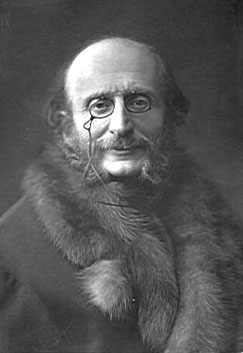 |
| Glasses: not Photoshopped in, apparently. |
In 1849, Jacques was back in Paris, and became the musical director of the Comédie Française that year. He founded a group called the "Théâtre des Bouffes-Parisiens" in the early 1850s, and they often premiered his operettas. Apart from his own works, the Bouffes-Parisiens also staged works by Rossini and Mozart, though always on a small scale - there were government restrictions on licensing performers, so until the laws were repealed in 1858, Offenbach could only put on productions with a handful of actors per piece. In 1858, not coincidentally at all, Offenbach's first large-scale work - Orpheus In the Underworld - was premiered. An incendiary review turned the piece into a controversial work, which then rendered it wildly successful. 1860 saw Offenbach granted full French citizenship, and the 1860s were a comfortable and successful decade for him. The Franco-Prussian war brought about a turn for the worse, however; the French people turned on Napoleon III, and Offenbach's music represented that regime to them. His popularity never waned in Vienna and England during this time, though, and he even embarked on a series of concerts in New York and Philadelphia in 1876. Offenbach was a great musical satirist - he poked fun of Meyerbeer, Berlioz, and Wagner among others, much to the first's amusement (and the second and third's chagrin). And in an example of everyone in the classical music world knowing each other somehow, he was one of the people who convinced a young Johann Strauss to write operettas. Toward the end of his life, he began work on a serious opera, The Tales of Hoffmann, but died in 1880 before its completion. Throughout his career, he wrote over eighty operettas, several ballets, and many other smaller works, all of which show a brilliant wit and a slightly evil sense of humor. The most well-known of these - in a way, of course - is Orpheus In the Underworld, from which our Galop, well, gallops.
 |
| The Can-Can: providing awful puns since 1830. |
The Can-Can music known and loved (or hated) is a dance in Hell by the Gods. Things don't get much better than that. Way to go, Offenbach. Your name may confuse people ("What do you need a Bach with a prefix for?" the naysayers naysay), your nationality may be suspect, and your single claim to fame these days may be used to sell cans, but it takes a rare composer indeed to make that scenario work. Maybe one day we'll pay attention to the rest of your music, too.
Further Listening:
Interested in what Offenbach's idea of 'serious opera' sounded like? (Hint: it's gorgeous.) Try the "Barcarolle" from The Tales of Hoffmann (performed by Anna Netrebko and Elina Garanca): http://www.youtube.com/watch?v=Hdc2zNgJIpY&feature=related
Did you know Offenbach wrote more than one Galop? Yup. And it's right here (from Geneviève de Brabant): http://www.youtube.com/watch?v=f3FOqtdUUUk
Thursday, September 29, 2011
"On the Beautiful Blue Danube"
The piece in question today can be found at around 4:10, though the entire cartoon is wonderful (and a particularly good parody of Fantasia, if I do say so myself). The melody of "On the Beautiful Blue Danube" is perfectly suited to the cartoon world, and - if I may be so bold - I don't think that Johann Strauss II would mind that. Strauss did not seem to have dreams of bold artistic statements, but instead was content writing popular music that got people up and dancing. A 19th-century Katy Perry (or Dr. Luke, for consistency's sake) to Richard Wagner's Radiohead, to complete the too-far-gone metaphor.
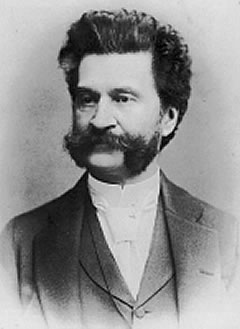 |
| Distressingly, not the largest his mustache ever was. |
Things were looking up for a while, until the Revolution of 1848, in which Johann (being a Twenty-Something Who Wants to Change the World) took the side of the revolutionaries. Papa Strauss was staunchly pro-monarchy, and the monarchs took a long time to fall in love with Strauss Jr. (an honorary title created for Johann Sr. was denied from his son for over twenty years after Sr.'s death, to name just one indignity). Johann Sr. died in 1849, at which point Jr. was finally able to assert his place in Viennese musical culture; and assert himself he did.
Some composers, like Beethoven, Schoenberg, and Wagner, look for new ways to express large artistic ideas, and the works they created stand testament to their forward-thinking artistic vision. Not so with Strauss. He wrote - for the most part - dance music. And he did it very well. Upon making a name for himself, he enjoyed a near-constant level of success that lasted the rest of his life. He toured in Russia and the United States, and was also well-liked by composers of his day. Richard Wagner himself mentioned that he enjoyed his waltzes, and Richard Strauss (no relation, of course) paid homage to him in several waltzes composed for his opera Rosenkavalier. Of course, Strauss did not simply write waltzes and other dance-hall music; he also composed several operettas (in a nutshell: shorter, decidedly less serious operas). Though these are not well-known today, I hold that Rodgers and Hammerstein got a lot of inspiration from them (seriously: there are pieces in Der Zigeunerbaron that sound like Carousel or The Sound of Music, just in German). Strauss died in 1899 at 73, after a very successful - if not ground-breaking - career, a well-loved composer.
 |
| If done correctly, your waltz should be clearly outlined. |
The "Blue Danube" waltz (or, as it is wordily-known in German, An der schönen blauen Donau) was composed in 1866 and premiered the next February. It was not a runaway hit at first, and during the revision process, words were added (and then subtracted). Finally, at the 1867 World's Fair, it was premiered in its finalized form to great acclaim. To call it a single waltz is a bit of a misnomer; it is really a collection of ten small, thematically similar waltzes strung together. However, as a whole, it proved to be extraordinarily successful. It has become somewhat of an unofficial national anthem for Austria, and was used quite notably in the docking scene in - of course - 2001: A Space Odyssey, which also featured Mr. Richard Strauss's Also Sprach Zarathustra. For someone who never purported to be making art music, Johann Strauss sure rubbed shoulders with the greats. If there's a moral here, it's that not every artist has to be preoccupied with High Art - there's quite a lot of dignity in the enjoyable. There's room for the Katy Perrys of the world right up with the Radioheads, and I think that's a most excellent thing.
Further Listening:
Don't believe me that Strauss operetta could be Rodgers and Hammerstein in German? Try "Wer uns getraut..." from Der Zigeunerbaron, performed by Carmen Monarcha and Morschi Franz: http://www.youtube.com/watch?v=I-_F2D486k8&feature=related
Want to see what the 'high-art' form of the waltz became? Try "Valse Brilliant #1" by Chopin, performed by Lang Lang: http://www.youtube.com/watch?v=viHg_kIWUeI
Interested in hearing how Beethoven paid the bills? Try Contredanses 3-7 (and check out the original theme from the Eroica symphony at 1:35!) performed by the Russian National Orchestra: http://www.youtube.com/watch?v=WfWyXW6ETlI
Thursday, September 22, 2011
The Four Seasons
Another day, another vindication. I had been asked to do this post, because it's true that these pieces are everywhere. The first of these is featured in almost every lazy film where people are meant to look snooty while sipping tea out in their formal gardens while being served by extravagantly mustachioed butlers. The second has been hardly spared, either, though I will say that it was the first one that was most recently featured in a commercial touting colon health. What "Spring" from Vivaldi's Four Seasons has to do with the lower intestine is beyond me, but I suppose any publicity is good 250 years post mortem.
 |
| Vivaldi in a nutshell. Though the red robe is cheating. |
At 25, he also began a long working relationship with the Ospedale della Pietà in Venice, an orphanage that was oddly forward-thinking. There were five of these orphanages in Venice at the time, and while the boys were eventually trained for a trade, the girls were educated in music - and this was a HUGE deal, as women were generally not allowed to see music as anything more than a hobby. The Pietà featured a choir and orchestra entirely comprised of women and girls, and they were, from all accounts, incredible. Vivaldi began there as a violin teacher, and spent many years working up the ranks at the orphanage until in 1716, he was named the music director of the entire organization.
In 1705, when Vivaldi was 27, his first collection of compositions was published. These were mostly sonatas and other smaller forms of music, though he was about to embark on a long and decidedly fruitful career as an opera composer. Italy (both at the time, and, arguably, for about two hundred years afterward) was the center of opera - still a somewhat new art form at the time - and in 1713, Vivaldi jumped on the bandwagon with Ottone in villa. In his lifetime, he composed at least 50 and as many as 95 operas, and the fact that attention hasn't been paid to them is really quite surprising. Between the late 1710s and 1725, he moved around Italy, living in Mantua, Rome, and Milan, but by 1725 - the year The Four Seasons was premiered - he was back in Venice. He was wildly successful for a time, but by his middle age, he was considered out of style and moved to Vienna to try and make a fresh start. It didn't work out, unfortunately, and he died there at the age of 63, all but penniless. To rub salt in that indignity, Vivaldi was never given the 19th-century renaissance that Handel and Bach both (posthumously, of course) enjoyed. It wasn't until the 1920s that interest in Vivaldi was rekindled - and even now, he is really only known for one work, though his catalogue is gigantic. But yes - enough lamenting his lack of acknowledgement. On to The Four Seasons.
 |
| Ha. Ha ha. So clever it hurts sometimes. |
Beyond being a set of four elegant concertos, The Four Seasons may be one of the earliest examples of program music. Composers have tried for hundreds of years to evoke specific emotions or even concrete images with music. In vocal pieces, this is called word painting - an example being a rising melody line on words that imply height, such as 'mountain' or 'sky.' Program music takes this idea further by giving an entire narrative to instrumental music. The Four Seasons were written to accompany four sonnets that may have been written by Vivaldi himself, and if they were, then they are some of the earliest examples of programs being prescribed to instrumental pieces. Vivaldi liked the music he composed for the set so much that he transplanted the opening of the "Spring" concerto to the beginning of his pastoral opera Dorilla in Tempe. And today, well... it's been transplanted to people trying to make colon health fancy. Not exactly the highest of praise, I suppose, but at least it's something.
Further listening:
Didn't think Baroque composers could ever do anything that wasn't elegant and a bit snooty (to our ears, at least)? Try "Le chaos" from Les élémens by Jean-Féry Rebel (composed in 1737): http://www.youtube.com/watch?v=dnlaCenlNHk
Want to hear Spring in a whole new light (while being inexplicably stared at by a disrobing man - hey, it's Youtube)? Try "Dell'aura al sussurar" from Dorilla in Tempe: http://www.youtube.com/watch?v=JcgpYWpguRs
Want living proof that you don't have to be aloof, and that you can even just about rip the notes out of the air with your teeth, while singing Baroque arias? Try "Agitata da due venti" from Griselda, performed by Cecilia Bartoli: http://www.youtube.com/watch?v=rISjBGOtHhs
BONUS: My favorite example of word painting ever (by a man who'd had just about enough of it, thank you very much). "Zefiro torna e di soavi accenti" by Claudio Monteverdi, sung by Philippe Jaroussky and Nuria Rial. (Find lyrics and a translation for this one - Claudio was really being a jerk about it, and it's kind of hilarious.) http://www.youtube.com/watch?v=zq49rymjvNg&feature=related
Thursday, September 15, 2011
Canon in D
Before we get to today's post, a slight vindication for me, and the purpose of this blog: I was watching television last night, and there was a new commercial for that toilet cleaner with Scrubbing Bubbles. Y'know what the music behind it was? That's right. Also Sprach Zarathustra. So now poor old Strauss has to deal with toilet bowls, too.
But yes. Back to today's piece. This composer had the distinct bad luck of following Bach's trajectory from relative anonymity to surprise success, except he predated Bach by 30 years (and is, in fact, the earliest composer featured on Where'd I Hear That thus far! It's the little things, really) and no one cares about any of his other works. However, the one piece he is remembered for has the somewhat dubious honor of, in some ways, representing Baroque music as a whole. That's right, folks - Pachelbel's Canon in D.
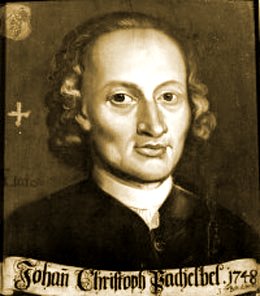 |
| If you look quickly, he looks eerily like Helena Bonham Carter. |
In 1677, Pachelbel moved to Eisenach. And who would he befriend in Eisenach than one Johann Ambrosius Bach, the father of our man Sebastian. He stayed in the town for only a year, but when he moved to Erfurt he stayed quite close to the Bachs - among other things, he was the godfather to one of Ambrosius' daughters, taught his oldest children music, and rented a house owned by one of Ambrosius' brothers. He stayed in Erfurt for a dozen years, and had a contract involving composition of church service organ preludes and large-scale early works. He married in 1681, but his wife and only child died from plague in 1683. His second marriage, in 1684, produced seven children, and one of them - Charles Theodore (moving away from Johann at last!) - moved to the American colonies in the 1730s. Charles lived in Boston, Newport, Rhode Island, and Charleston, South Carolina, and gave several concerts in New York City and was a rather well-known composer of church music in America. While he was raising his children, Johann Pachelbel turned down posts in Stuttgart and Oxford University to accept a position in Nuremberg, where he lived until his death in 1706. In life, he was never hugely well-known, though his influence can be seen through Charles' American church music as well as J.S. Bach's early organ music (due to one of his first teachers being one of his brothers - and Pachelbel's students).
 |
| Ha. Ha. |
As tends to happen, Pachelbel's Canon was entirely ignored, then forgotten, for over two hundred years. It was analyzed in a musciological paper in the 1910s, but stayed in the circles of the truly nerdy (said as a compliment, of course) until 1970, when Jean-François Paillard recorded it in 1970, and more so in 1980, when it was featured in the film Ordinary People. Since then, it has been a staple in the public concept of what Classical Music is - but perhaps its more insidious legacy was that of providing the chord progression to thousands of popular songs since the 1970s. Just ask this angry man with an acoustic guitar (the actual examples start roughly 2 minutes in).
Further listening:
Interested in the bizarre and awesome stuff one can do with the canon form? Try Bach's "Musical Offering," in which he writes a canon that modulates up a step every time there is a repetition (and can go on as long as the player wishes): http://www.youtube.com/watch?v=nsgdZFIdmeo&feature=related
Because I feel bad for the guy, here's the other half of his Canon and Gigue: http://www.youtube.com/watch?v=zv_s4Q6wRKo&feature=related
Wanna hear what a German composer with enough melodrama to kill lesser men (again, said out of love) can do to a well-known and beloved children's round? Try the third movement of Gustav Mahler's "Titan" Symphony no. 1, performed by the San Francisco Symphony Orchestra: http://www.youtube.com/watch?v=WVsLCzSK7Rs
Thursday, September 8, 2011
Another new way to follow the blog!
So apparently, Blogger finally listened to the moaning of hundreds of bloggers who were irritated that there was no in-house way of doing the follow-by-email thing. Because now you can!
On the top right-hand side of the page, there is now a nifty little "Follow by e-mail!" heading with a box in which an e-mail address can be submitted. By putting your address in there, the only things that should be sent to you are the new blog posts. If there are any other surprises, let me know and I'll smite Blogger. Or something.
"Pomp and Circumstance" March #1
(Note: for what we're talking about today, skip ahead to 4:55.)
In honor of the thousands of college seniors that put on their caps and gowns in the past week or so (decidedly prematurely to them, of course), today's post is on a piece that has grown to be synonymous with the American graduation. In fact, the composer of said graduation theme is pretty much the perfect embodiment of the "Plug Away At What You Love And Eventually It'll Pay Off" school of the American dream. Shame he was British, that.
 |
| It's so co-o-o-old. |
Instead, young-man Edward took up several jobs in Worcester including (but not limited to) the conductor of the residents' band at the Worcester and County Lunatic Asylum and the Professor of Violin at the Worcester College for the Blind Sons of Gentlemen. Both positions were instrumental (if you'll excuse my language) in cultivating Elgar's compositional sensibilities, but it must be said that there must have been something in the water in Worcester. Either that, or English gentlemen had an overwhelming propensity for siring blind male children, because that is a very specific school. In 1889, he married his wife, Alice - eight years his senior, and from a family who most decidedly did not approve of her marrying a musician/composer with no apparent future. Theirs was a rather disappointingly normal marriage (particularly for artistic types)- they loved each other very much, and she managed his business affairs until her death. However, though Elgar worked continuously, he could not help but prove Alice's family correct - he never seemed to catch a break.
 |
| If this isn't your idea of turn-of-the-century England, you're doing it wrong. |
 |
| I mean, how much more hopeful and glorious can you get? |
In this age of, y'know, economic uncertainty, a job market that's gone down the drain, and general anxiety about the future, it's nice to know that Edward Elgar managed to make it in the world due to sheer perserverance. But then again, in that case, perhaps I should just move to England. Seems to have worked out for him.
Further listening:
Like pomp, perhaps even a little circumstance, and the English? Try "Jupiter," from Holst's The Planets (performed by the Chicago Symphony Orchestra, conducted by James Levine): http://www.youtube.com/watch?v=Nz0b4STz1lo
Like Elgar, but perhaps a little less of the aforementioned adjectives? Try the "Nimrod" variation, also performed by the Chicago Symphony Orchestra (but conducted by David Barenboim this time): http://www.youtube.com/watch?v=sUgoBb8m1eE
Like Elgar, and also the fact that love songs have existed for as long as there have been music? Try "Salut d'Amour", written for Elgar's wife Alice: http://www.youtube.com/watch?v=BSv3iApK3DQ
Monday, September 5, 2011
"Clair de Lune"
Gettin' back to basics. Either that or I finally was able to actually find an iconic scene from a movie that features a piece of classical music. The ending scene of Ocean's Eleven is one that is quite well-known indeed, and Claude Debussy's "Clair de Lune" (or, at least, one of the orchestrations of "Clair de Lune" - but we'll get there soon enough) is a piece that is instantly recognizable - not just from this movie, of course, but in just about anything where a feeling of languid reverie is desired. Not too shabby for a man who was never really seen as more than a bizarre little composer by Those That Know More About Music Than You in his time.
 |
| Debussy, looking rather smug and Gallic. |
In 1888, Debussy traveled to Bayreuth in what appeared to be a rite of passage for young composers by this time, and was floored by what he saw there. Though his music never featured the extreme emotional highs and lows of Wagner, he was still influenced by his unusual harmonic progressions (though in a particularly sassy moment, he did turn the beginning of Wagner's Tristan und Isolde into a big ol' joke - to great effect, no less, even including a bout of the giggles played by the piano accompaniment immediately after the quote). Around this time, he met and became friends with Erik Satie, another French composer who shared Debussy's somewhat iconoclastic musical tastes. He had several tumultuous love affairs, but as a personality, was never particularly well-known during his own lifetime (though he was able to afford a rather comfortable lifestyle). In what he saw as a rather grave insult, he was given the adjective "impressionist" as a way to describe his music; however, the similarities between his music and impressionist art can't be denied (for one, his lack of orthodox harmony leads to a sort of blurred-around-the-edges quality to his music). His music ended up being incredibly important in the grand scheme of music history exactly because of that lack of orthodox harmony - he ran with what Wagner did in terms of breaking away from classical harmonic theory and introducing things like the whole-tone and pentatonic scales, as well as bringing back the medieval modes.
 |
| Useful Image #2!! |
 |
| And #3!! Man, this is getting downright educational... |
Hah. "Very quickly," indeed. Hey - it's not my fault that Debussy was into all this weird musical stuff.
 |
| This is perhaps not what Debussy had in mind. |
So there you have it - a piece that represents quite a lot in the theory world. I hope I didn't get too pedantic with the theory; I know that's really not the most interesting thing in the world to read. But hey, the school year's starting again, and perhaps someone will Google "just how the hell do modes make sense?" and this entry will help them out. Debussy might even be a little proud of that, but then again, he was always a little bizarre.
Further listening:
Didn't know the French had a sense of humor? They sure do, when they make fun of Germans! Try his "Golliwog's Cakewalk" (the joke being at around 1:15): http://www.youtube.com/watch?v=tnkBhv5WsRw&feature=related
Interested in hearing why Debussy hating the term 'impressionist music' is a little silly? Try "Prelude to the Afternoon of a Faun": http://www.youtube.com/watch?v=9_7loz-HWUM
Want to hear the most brazen example of the whole-tone scale in Debussy's work? Try "Voiles" from Preludes, book 1: http://www.youtube.com/watch?v=FVV0jkZC4jI
Thursday, September 1, 2011
A new way of getting Where'd I Hear That posts!
Hopefully, of course.
I've just set up a Google Group - if any of you so choose, you can opt to get any new posts made e-mailed to you instead of having to look at the blog itself. To become a member of the group, e-mail wheredihearthat@googlegroups.com, and if all goes well, you'll get your twice-weekly dose of classical music knowledge in no time!
"Largo al factotum" from "Il barbiere di Siviglia"
That's right, going with this week's apparent theme of "Posts I Should've Written Ages Ago," as well as in honor of the Metropolitan Opera's Summer HD Festival, today's piece is the reason this blog exists. A decidedly silly piece of music written by a very impressive young man, "Largo al factotum" from Rossini's Il barbiere di Siviglia (or, for the less pretentious among us, The Barber of Seville) has been relegated to Looney Tunes and the Jersey Shore, but what it represents in music history is so large it's almost ridiculous. Not only is Il barbiere di Siviglia considered the archetypal opera buffa (a genre of opera that spawned its own voice type, no less), but Rossini is one third of what is known as the bel canto era. All of these italicized, Italianate terms will be expounded upon, of course, but suffice it to say, "Largo al factotum" is much bigger than the sum of its parts.
 |
| Every picture of Rossini has this "I know something awful about you" look to it. |
Gioachino Antonio Rossini was born in 1792 in Pesaro, Italy to a family of musicians; his father was a horn player and his mother was a professional singer. His childhood was somewhat turbulent - his father was jailed for his political leanings, and his mother would often have to travel to perform and keep her son fed and clothed. He learned the fundamentals of music from Angelo Tesei, and his first compositions were six string quartets, written at the age of twelve. Gioachino really, really liked Mozart, to the point that his classmates would call him "The German" in jest. His first opera was written when he was fourteen, but was not premiered until he was twenty. His first premiered opera was La cambiale di matrimonio (or "The Marriage Contract"), produced when he was just eighteen. He found international acclaim with the premiere of Tancredi at twenty, and from that moment on, he never lacked in fame or finance.
Even in his early career, he was transforming the operatic world - in Tancredi, he began the practice of writing out ornaments for singers instead of letting them come up with them for themselves. This doesn't sound like a huge deal, and it wouldn't be if not for the fact that no one did that before. In Baroque opera, a defining feature was the da capo aria, in which was contained a melody to be sung through relatively straight the first time, a contrasting second section, and then a repeat of the first in which the aim was to sing the hell out of that melody, adding as many displays of virtuosity as possible. Writing out the ornamentation made the arias less showpieces (though, clearly, they were still showpieces that could stand alone in recital) and tied them closer to the dramatic aspects of the opera. Il barbiere di Siviglia premiered in 1816, when Rossini was twenty-four, and that is where our biography of the man will end for now (though he did live to the age of 76). For one, I've got to keep enough to write about when we get to the overture of Guillaume Tell...
| Apparently this is from a Haydn opera buffa. Very silly indeed. |
 |
| If you forget the second 'f' when typing buffo, this is what you find. |
Further listening:
Want to hear one of the best (and earliest) examples of basso buffo? Try "Madamina, il catalogo è questa" from Mozart's Don Giovanni (performed by Richard Cassell): http://www.youtube.com/watch?v=rYUlCropCGY
Equally interested in da capo arias with some truly delightful choreography? Try "Non disperar" from Handel's Giulio Cesare (performed by Danielle de Niese): http://www.youtube.com/watch?v=AhLluWn3UKY
Monday, August 29, 2011
Hungarian Rhapsody #2
Ah, the good old days, when entertainment meant for children thought nothing of making a cartoon based solely off a piece of classical music over five minutes long. What an interesting concept. It certainly wouldn't work these days, but ah well. What can you do? I will say, though, that I have a feeling that Franz Liszt (yes! I've finally done the post I've been promising for the past month) would not have objected too strenuously to the over-the-top performance done here by Messrs. Tom and Jerry.
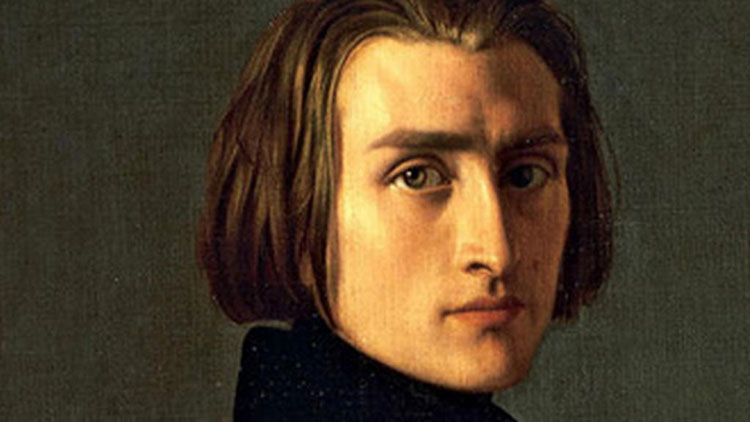 |
| With that brooding stare, you'd want his gloves too. Don't lie. |
Liszt married rather young and had three children with his first wife in rapid succession. His daughter, Cosima, became rather well known for, y'know, marrying Richard Wagner and starting the Bayreuth festival. (It's truly fascinating how tight-knit the musical world can be sometimes, isn't it?) In the 1840s, Franz took up a touring life to support his growing family, and to say that it was a success is to put it far too mildly. Liszt was a phenomenon - of the likes of Elvis. Women (and, I'm sure, at least a few men) went absolutely wild over his performances, and would grapple for souvenirs of silk gloves and handkerchiefs. He was so successful that he was able to retire from concert life at the age of 35, not only financially set for life but able to quit at the top of his game, so to speak. He moved to Weimar and stayed there for quite some time, but the death of two of his children and a failed romance sent Liszt to Rome, where he lived in solitude for several years. For the last ten years of his life, Liszt split his time between Rome, Weimar, and Budapest, composing and giving master classes. He died at Bayreuth in 1886, during the festival his daughter started.
 |
| Though he probably should've bit the bullet and cut his hair later in life... |
Though Liszt is known mostly for his piano music, it must not be forgotten that he was also the inventor of the symphonic poem, a genre of music without which 2001: A Space Odyssey would be decidedly less epic. However, since Hungarian Rhapsody #2 is indeed a piece of piano music (or at least was originally a piece of piano music), it is there we shall stay. Because Liszt was Hungarian, it only followed that he was strongly influenced by Romani music and made use of the Gypsy scale. This scale is formed by taking an A minor scale (A B C D E F G) and raising the fourth note of it, giving A B C D# E F G. This can clearly be used in any key - the Hungarian Rhapsody is in C# Minor - but for the sake of not having a million #s, A minor is the easiest to see.
The Rhapsody itself was composed in 1847 and published in 1851 as part of a set of 19. Originally arranged as a piano solo, the overwhelming popularity of the pieces gave Liszt the opportunity to arrange it first for piano and orchestra and then for piano duet. It became part of the standard piano recital repertoire very quickly, and for a time, almost every recital ended with the piece due to its outstanding virtuosity. This near-ubiquity gave companies like Warner Brothers and Hanna-Barbera the license to use the piece all over the place; apart from the Tom and Jerry cartoon, there is a Bugs Bunny short, a few Disney cartoons, and even a song in Animaniacs. I can't say that this would be the first piece of music I would personally pick to become the unofficial cartoon anthem, but it seems to have worked for the past 75 years or so. Go figure.
Further listening:
Like Liszt, and also Mozart? Try Reminiscences de Don Juan, performed by Valentina Lisitsa: http://www.youtube.com/watch?v=_xSZ860AbOw
Like Liszt, and also having lots of feelings? Try Liebestraum no. 3, performed by Daniel Barenboim: http://www.youtube.com/watch?v=Y4XEPdYO5mM&feature=related
And in honor of the beginning of school years across the world (but mostly Vassar's), here's his Gaudeamus igitur paraphrase: http://www.youtube.com/watch?v=P0s4zCFSLcw
And finally, for creepiness' sake, a cast made of his hands:

Thursday, August 25, 2011
Peer Gynt
In an odd way, this post is a bit of a culmination of quite a few posts that I have made over the past month or so. First off, it's another case of a multi-movement piece of music having more than one movement become wildly popular. Second off, it's another case of incidental theatre music far outstripping the play itself in terms of being well-known. And thirdly, the second piece illustrates a freaking sunrise. Not a bad way to cap off a month of blogging, I'd say. The piece, incidentally (I'm going to get so much grie
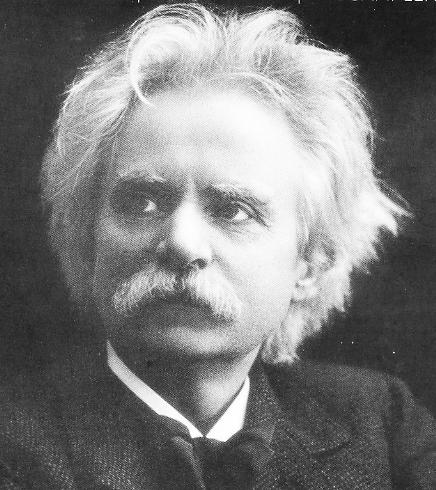 |
| Grieg, age fifteen, wearing a wig and false mustache to appear older. |
In 1874, Henrik Ibsen asked Grieg to write incidental music (for those who have forgotten or who have not been following this blog since its inception - and shame on you for that - incidental music is music written for a play that is not necessary for the plot's development) for his play in verse Peer Gynt, and Peer Gynt was premiered in February of 1876. Though the play itself is performed quite often in Norway, its extraordinary length has kept it from being part of the theatrical canon pretty much anywhere else. Besides which, as seems to be the case for much 'incidental' music, the music itself has gone on to wild international popularity.
The character Peer Gynt is a young man of rather disreputable character, often getting drunk and having to quickly leave messy situations he has created. Booze is a central factor in many of Gynt's misadventures, be it stumbling into a wedding to try and wrest the girl he loves from her husband-to-be or, y'know, hitting his head on a rock and dreaming up an entire civilization of trolls.
 |
| What I sincerely hope Gynt saw. Thanks, Harpsterdraws! |
"Morning Mood," or "That piece in every single morning scene in Looney Tunes," is the prelude to Act IV. Also Sprach Zarathustra's more timid cousin, "Morning Mood" also tries (and succeeds, in my estimations) to paint a sunrise with music. Though it is decidedly less epic and more pastoral than Zarathustra, sometimes that's just what is needed - particularly when milkmaids are concerned.
A small addendum: Peer Gynt also includes, much in the vein of Aaron Copland, a piece of fiddle music he couldn't seem to put down. First he turned it into a solo piano piece:
Then he added it smack dab into the middle of the opening of Peer Gynt (skip to 1:50 to hear it):
Sometimes it's best to know when to put a good thing down, yes, but it's equally good to know when to milk it for all it's worth.
Further Listening:
Like Grieg, and also heartbreaking works of staggering beauty? Try "Solveig's Song" from Peer Gynt, performed by Anna Netrebko: http://www.youtube.com/watch?v=2AZL0FcQDV0&feature=related
Like Grieg, and also piano concertos? Guess what this is going to be, then: http://www.youtube.com/watch?v=9ypR4VKi1TM&feature=related
Monday, August 22, 2011
Jesu, Joy of Man's Desiring
Sometimes, I wonder just what I can get away with on this blog; and then I realize that I can get away with just about anything, as long as it's not factually incorrect. Yes, that's Celtic Woman. I'm almost sorry for posting it, but then again, after the atrocity that was "Handel's Messiah Rocks," this is just about beautiful and tasteful. Yet another case of a piece with no delusions of grandeur becoming a beloved piece of music (and easily a Top Five contender in terms of wedding marches, though I've always privately wondered how one processes down the aisle in 9/8 time...), "Jesu, Joy of Man's Desiring" does deserve the attention heaped upon it - though I must say, I'm not entirely sure anyone actually deserves Celtic Woman.
 |
| I've always wondered what wigless Bach looked like... |
In 1721, he met Anna Magdalena, married her that year and eventually had thirteen children with her. Add that to the seven had had from his previous marriage and you have a very productive man. True to the Bach heritage, many of his children became musicians and composers in their own right, including Carl Philip Emmanuel and Johann Christian (again with the Johann...), the latter of which moved to London and became friends with (and influenced) one young Wolfgang Amadeus Mozart. It all comes around, doesn't it?
From 1723 until his death, Bach worked in Leipzig as the Cantor of the Thomasschule (or Thomas School) at St. Thomas Church, and as part of the job, he had to conduct a cantata each Sunday. True to form, he took it upon himself to write new works most of the time, eventually composing upwards of 200 of them. At the end of his life, he began to go blind and opted for eye surgery, which was a huge gamble in the mid-eighteenth century. Unfortunately, it was a gamble that cost him his life, and he died in 1750 at the age of 65 from complications due to that surgery. To add posthumous insult to, well, death, his music was almost entirely ignored for nearly eighty years by the general public. Composers, for the most part, revered him (Beethoven declared him the Father of Harmony, for one), but the public saw his work as old-fashioned and even stodgy. Between you and me, though, I don't think Bach would have minded either of those two adjectives. In 1829, though, Felix Mendelssohn performed Bach's St. Matthew Passion for the first time since the 18th century, and that set in motion a chain of events that led to Bach becoming one of the world's best-known and most-loved composers.
 |
| Let it be known that this is the first useful picture on this blog. |
This would be a nice distinction, except for the fact that nothing can ever be a nice distinction when it comes to musical terms. Cantatas became more and more theatrical, and in Bach's case, sometimes became indistinguishable from opera scenes and oratorios. It is said that Bach never wrote an opera, which is technically true - he did, however, compose a 'cantata' about a young woman's coffee addiction, complete with arias, duets, and recitatives. Furthermore, Bach's "Christmas Oratorio" is simply six separate cantatas bound into one whole. One way cantatas can be distinguished, however, is their length - they tend to be shorter than operas and oratorios - so if you're ever presented with a short vocal piece in several movements that may or may not include a choir, you can pretty safely call it a cantata without incurring the wrath of someone who's decided they know more than you about classical music.
 |
| I didn't know people actually did this. |
"Jesu, Joy of Man's Desiring" is the tenth and final movement of Herz und Mund und Tat und Leben (Heart and Mind and Deed and Life), composed in 1716 during Bach's Weimar days. The German title of the movement is "Jesus bleibet meine Freude," or "Jesus shall remain my gladness" - similar enough, but perhaps a bit more selfish. The melody was actually written by one Johann Schop, and Bach liked it so much that he used it again in the St. Matthew Passion. Its simple beauty gives it a heart-wrenching quality, and though Bach intended it to be performed at a rather brisk tempo, the slow, meditative pace used in most performances these days gives the piece an element of the sublime. Hey - if it's good enough for Celtic Woman, it's good enough for me.
Further listening:
Interested in the advent of the cantata? Try "Mad Bess" by Henry Purcell (sung by Drew Minter): http://www.youtube.com/watch?v=aUwCKkDIsRw
Like beautiful pieces by Bach that aren't actually by Bach? Try "Bist du bei mir" by Gottfried Heinrich Stölzel (sung by Laura Heims): http://www.youtube.com/watch?v=FWnEUzUizkI
Like Bach, and also happiness? Try "Wir eilen mit schwachen" from Jesu, der du meine Seele: http://www.youtube.com/watch?v=iY3XAPqGy_Q&feature=related
Thursday, August 18, 2011
The 'Hallelujah Chorus' from "Messiah"
This piece, much like the few before it, has transcended the 'I've heard this somewhere' label and has graduated to 'I've heard this everywhere.' Unlike the few pieces before this one, however, this was not a case of a small-scale work becoming surprisingly adored. No, George Frideric Handel's Messiah was beloved in its time, never suffered a dip in popularity, and continues to be performed nearly constantly (particularly around the holidays). But, as always, the story behind the piece (and of the man himself) is too good to pass up, and so here we are today.
 |
| Handel, looking only slightly incredulous. |
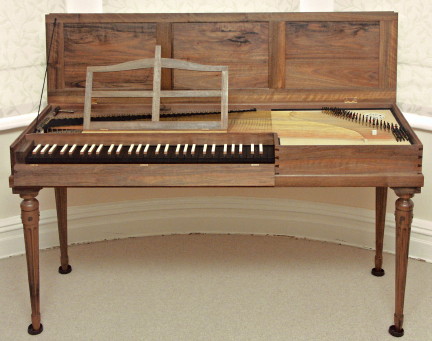 |
| My-Size Clavichord, perfect for kids whose parents Just Don't Understand. |
Luckily for him, however, he was about to strike musical gold. In July of 1741, Charles Jennens wrote a letter to Handel (George by this time, having been adopted by the British as one of their own) mentioning a new libretto he had for an oratorio called Messiah.
At this point, I feel obligated to take a moment and explain the differences between opera and oratorio. On paper, they are very similar pieces of performance art; both feature orchestral accompaniment, a chorus, and vocal soloists. The difference - in theory at least - is in intent and subject matter. An opera is a musical work written for the stage, while an oratorio is generally thought of as a concert work. In terms of subject matter, operas tend to be mythological, historical, or literary, while oratorios tend to be based on sacred texts. However, Handel's oratorios (particularly Samson) are often staged, and his oratorio Semele caused incredible consternation due to its basis on Greek myth. If you are ever confused as to whether a work is an opera or oratorio, your best bet is to ask someone who has decided they know more about classical music than you and take their opinion as fact. It works for me.
 |
| I can only guess (and dread) what this sounds like. |
Messiah was premiered in Dublin in 1742 to great acclaim, but when it premiered in London, receptions were decidedly more lukewarm. Jennens himself was rather displeased, thinking that Handel's music did not do his libretto justice. However, after a slow start, Messiah became a beloved piece of British music that has never left the repertory since.
A fun fact: the performanace of "Hallelujah" above is based off an arrangement done by none other than Wolfgang Amadeus Mozart in 1789 on commission from one Baron von Swieten. Performances of Messiah got bigger and grander (one featuring a chorus of 2,000 and an orchestra of 500) until the twentieth century, when a revival in Baroque performance techniques led to an interest in hearing how it was performed at the time.
People do like things big, though, and so we can't always fault Andre Rieu - our conductor in the top video - for his excesses.
Further listening:
Like Handel, and also happiness? Try "Happy We" from Acis and Galatea (performed by Les Arts Florissants, sung by Paul Agnew and Sophie Daneman): http://www.youtube.com/watch?v=ESKvWcTh4AE
Interested in Handel's Italian opera? Try "Ciel e terra armi di sdegno" from Tamerlano (sung by Rolando Villazón): http://www.youtube.com/watch?v=8PnXEQKKp1U
Like Handel, and also really beautiful music? Try "Un momento di contento" from Alcina (sung by Kobie van Rensburg): http://www.youtube.com/watch?v=VrMHHGR_KR8
Yeah, I know. I like Handel. So should you.
Subscribe to:
Posts (Atom)